

'La Mascotte'
Bulldogs, the American Civil War, and a French Opera's influence on College Football

Overview
As the 156th season of College Football kicked off last weekend, it felt an opportune time to further examine the origins of how the team mascot found its way into college athletics, and the clear influence bulldogs played in creating this cultural phenomenon.
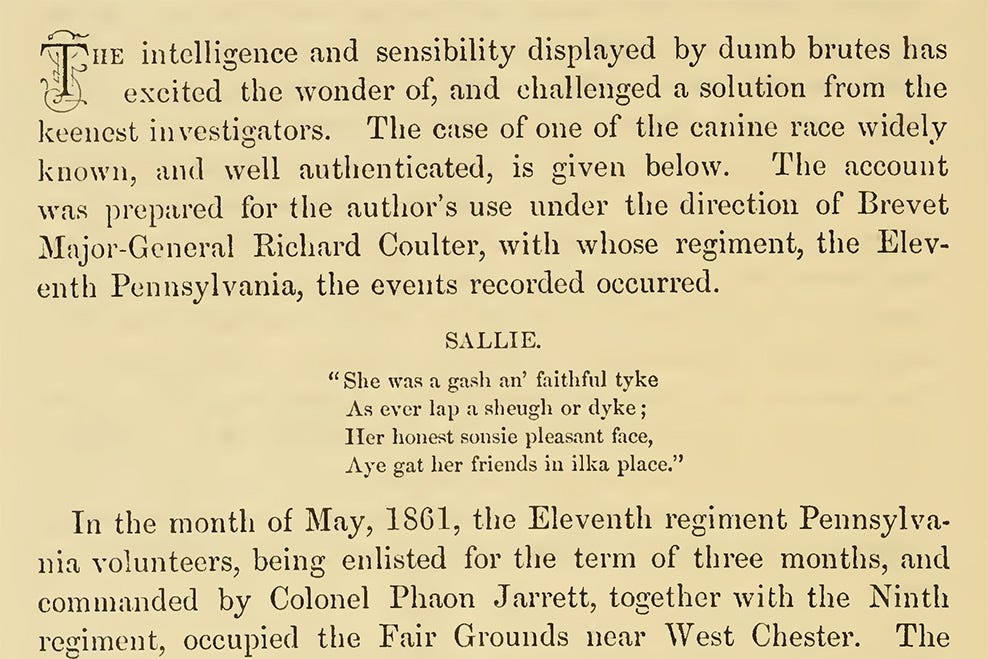
A Civil War Dog Named Sallie
The compelling story about Sallie Ann Jarrett was one of the first I heard during the initial year of research for “Guilty ‘Til Proven Innocent“ - my directorial debut for a documentary about pit bull dogs and breed specific legislation.
On a five-day roadtrip while conducting interviews on the east coast in May of 2008, I made Gettysburg my final stop before heading home…just so I can sit next to Sallie and gaze off in the same field her feet once walked on.
The first time I saw Sallie, I remember thinking how small she was - probably 30 pounds, at most…and, yet, her legacy continues to live on a century and a half later as if it happened just a short time ago.
She was born sometime in the spring of 1861 near West Chester, PA, at the onset of the American Civil War.
According to ‘Martial Deeds of Pennsylvania’, a book published in 1875, Sallie was given as a gift to the 11th Pennsylvania Volunteer Infantry from a local man when she was barely a few weeks old.
As she matured, Sallie regularly took part in morning roll calls and other tactical drills, and the soldiers of the ‘Bloody Eleventh’ quickly became fond of her.
She was described as a brindle bull-and-terrier - a variety of an alleged fighting dog, that was created by breeding Old English Bulldogs to select types of terriers, with the intended outcome to produce a canine with a combination of traits admired in both.
Today, Sallie would have likely been referred to as a pit bull terrier.

There’s a painting by artist, Greg Stump, called “Loyal Heart” (above), which depicts a scene from the famous Battle of Gettysburg where the 11th Pennsylvania positioned itself along Oak Ridge on July 3, 1863.
At some point in the thick of the hostility, Sallie became separated from her regiment, but was returned the following morning by the Captain of the Twelfth Massachusetts. She was found licking the wounds of the injured soldiers and protecting the lifeless bodies of those who didn’t make it.
Hence - Loyal Heart.
Unfortunately, Sallie knew nothing but conflict in her life. She was born around the time the Civil War began, and killed on February 6, 1865 during the Battle of Hatcher’s Run, as the war was nearing its ending - two months prior to the surrender of the South.

At the conclusion, a military administrative officer in charge of providing the official reports wrote: “Sallie was killed when the regiment was making its first advance on the enemy. She was in line with the file-closers when shot. We buried her under the enemy’s fire.”
Much of what we know about Sallie is from letters written by the men of the unit, who often included her in their writings back home. One of those letters, dated February 11, 1865 - just days after her death, provided additional details about what transpired on the battlefield that day.
“Poor Sallie fell in the front line in the fight at the Run - a bullet pierced her brain. She was buried where she fell, by some of the boys, even whilst under a murderous fire, so much had they become attached to the poor brute, who so long had shared with them the toilsome march and the perils of the battle.”
Essentially what he wrote was, despite being of a different species, she shared the same burdens of combat these men experienced. She was one of them, but likely so much more than that.
I imagine her mere presence kept them sane in such an insanely violent time. Beyond just companionship, she was someone they could escape their reality with, who had the capacity to provide authentic and meaningful affection.
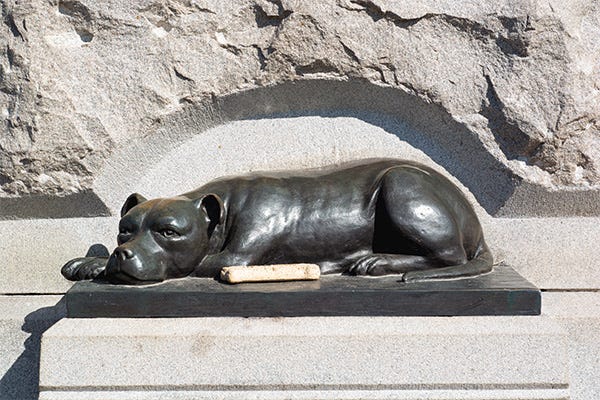
When a monument at Gettysburg for the 11th Pennsylvania was being discussed decades later, surviving members championed for Sallie, and insisted she be included in a life-sized bronze sculpture at the base of it.
She’s just one of two dogs immortalized on a monument in Gettysburg, and remains arguably the most famous of all dogs who participated in the conflict 160 years ago. You can find her here on Doubleday Avenue.
The Origins Of Football
Born out of the ashes of this dark period in American history, a new game was in its infancy of being invented.
American football emerged from two British sports - soccer and rugby, and was primarily being played in the north. The first recorded game was in 1869 between Rutgers and Princeton University.
In many way, it mimicked the type of warfare seen in the Civil War - the last great conflict in this country that was fought predominantly by foot soldiers, before the implementation of more sophisticated weaponry, such as planes, was introduced in subsequent wars.
The similarities between the two are even more plentiful.
Teams are led by head coaches - an equivalent to Generals, and have a ranking system with assistant and position coaches, that resembles a military hierarchy. On the field the goal is clear - strategize, attack and penetrate through the enemy’s defense (opposing team), and gain ground through the collective efforts of teamwork.
Each offensive possession simulates individual battles, and whoever scores the most points at the conclusion is declared the winner of the war.
Rule changes made shortly after by Yale’s, Walter Camp - often called the “Father of American Football”, in the 1870s and 1880s, began shaping the sport closer to the game we watch in the present time.
I wonder if they knew their sport would become the most popular game in the United States a century and a half later.
A French Opera, And The Making Of The Team Mascot
The history books of today refer to these infantry pets - such as Sallie of the 11th Pennsylvania, as mascots. The only problem with that is, the term ‘mascot’ didn’t actually exist at the time. In fact, it wasn’t coined until fifteen years after the Civil War.
Objectively speaking, it’s worthy to point out there were many species of animals…as well as humans, who were once viewed as lucky charms long before the mid-late 19th Century.
There’s evidence of some form or another of mascot-types being used all the way back to the Ancient World. They just weren’t called ‘mascots’.
The word, ‘mascot’ made its way into the English dictionary via a French word, ‘mascotte’, which originated from a wildly successful (French) opera titled “La Mascotte” in 1880; Translated in English to mean - The Mascot.
The basic premise was about a farmer who had a series of misfortunes, and how one woman possessed special powers that brought good luck to anyone around her…so long as she stayed a virgin (by the way, this was a comedy…again, from 1880).
In short, she was the mascot…she became his good luck charm, and thus a word was born to describe a person, animal, or inanimate object, used to symbolize an entity and (hopefully) bring them prosperity and good luck.
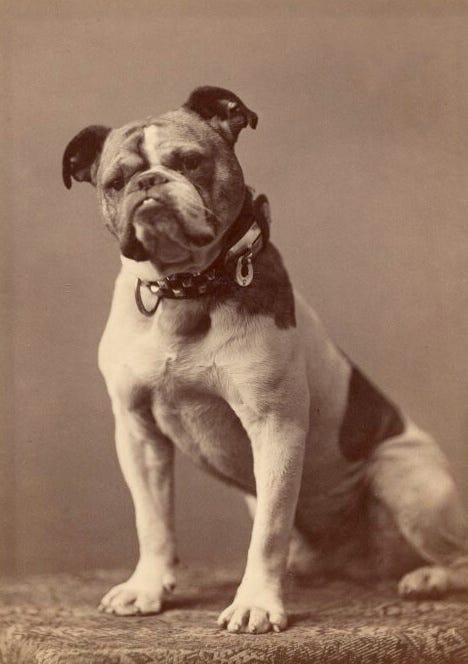
One of the earliest sports mascots was a bulldog named, Handsome Dan, who in 1889 became the first live animal mascot in collegiate sports when he was chosen to represent Yale.
Since that day, thousands of high schools, colleges, companies and organizations - even entire nations, have utilized the bulldog for representation, making them one of the most popular mascot choices throughout history.
Bulldogs: A Contradiction Of Great Proportions
It’s an odd paradox for an animal largely revered for being a symbol of strength, courage, fearlessness, grit and determination, while simultaneously also viewed as inherently dangerous and a public safety hazard.
This could most likely be explained by the increase in popularity of dogfighting and rise of the American dogfighter, after a famous match in October 1881 between Lloyd’s Pilot and Krieger’s Crib, which drew national and international interest.
The winner, Lloyd’s Pilot, claimed victory in what was dubbed as the first American Championship.

This event furthered the development of the gamebred American Pit Bull Terrier at the turn of the century, whose ancestors came from foundational stock of post-Civil War bull-and-terriers. Dogs such as Sallie Ann Jarrett.
But, I can’t help but think about the timing of these events.
Had it not been for a French opera, the world would never have been introduced to this new word ‘mascot’. Would we have found another word to describe these tribalistic sports symbols, who are used as rallying cries for team loyalty?
Would we have applied another word to Civil War dog legends like Sallie, Jack of the 102nd Pennsylvania Volunteers, Harvey of the ‘Barking Dog Regiment” (aka the 104th Ohio Infantry), as well as the countless other unknown or nameless animals pictured posing with Union and Confederate regiments?
I think it’s clear - for the men of the 11th Pennsylvania, Sallie represented so much more than a symbol for a military unit. She represented belonging to a family. And, that’s also what sports attempts to mimic.